
6min read
The Swiss were beaten by the French (LIP, R27) and the Americans (Elgin, 722; Hamilton, 500) in the race for the first electric wrist watch.
Ebauches SA and Omega were the first Swiss firms to react and Ebauches SA managed to market the L4750 by 1960 with widespread success. By 1955, Omega had the Battelle Institute in Geneva looking into the possibilities for a battery driven caliber, but after a meta-analysis of the possibilities, Battelle and Omega opted for the high frequency quartz system peaking in the development of the ‘Megaquartz 2.4MHz’ presented at the Basle Fair 1970.
The patent filed in 1955 by two engineers of Battelle for Omega featuring an electro-mechanical caliber has been reactivated in 1964, after the success of the battery driven systems of Ebauches SA, and after Ebauches SA seamed to have resolved the problem of sparking contacts by initiating the research into transistor equipped electric watches, which will become their, also highly successful, cal.: 9150 ‘Dynotron’ movement. Omega created a few prototype cal.: 6550, featuring an electro-mechanical system with two transistors and a balance wheel with integrated electromagnetic element, very similar to the one used by Hamilton, 7 years before and named them ‘Dynatron Electrondynamic’.
Less known is, that within the SSIH conglomerate, where Omega collaborated closely with Tissot, latter company was experimenting with alternative materials for calibers, such as plastics since 1952, patenting plastic movement elements starting from 1956. In 1964 Tissot started the research specifically targeting the development of an all plastic caliber which will become the mechanical ‘Astrolon’ launched in 1971 (1).

ESA’s cal.: 9150 Dynotron, the first transistorised, electric watch movement, was marketed 1967. By that time Omega was already working on its own transistorised, electric movement and after ESA’s release of cal.: 9150, they accelerated the development. Then, in April 1968, additionally motivated by the success of the revolutionary syfy movie ‘2001: A Space Odyssey’ Omega started to look into more futuristic features and took advantage from the research of the ‘Synthetic Materials Department’ of Tissot in Le Locle by having movement plates and parts plastic made there. These transparent plastic plates were used to adapt one further version of Omega’s electro-mechanical system, merging Omega’s electro-mechanical technology with Tissot’s advanced knowledge of alternative caliber materials (4).
The resulting caliber can be considered the earliest known all plastic, battery driven wrist watch movement, built 13 years before the inception of Swatch. One of only two known such movements is presented below.
–
Omega, Electrodynamic, SYTAL Prototype #51, 1968

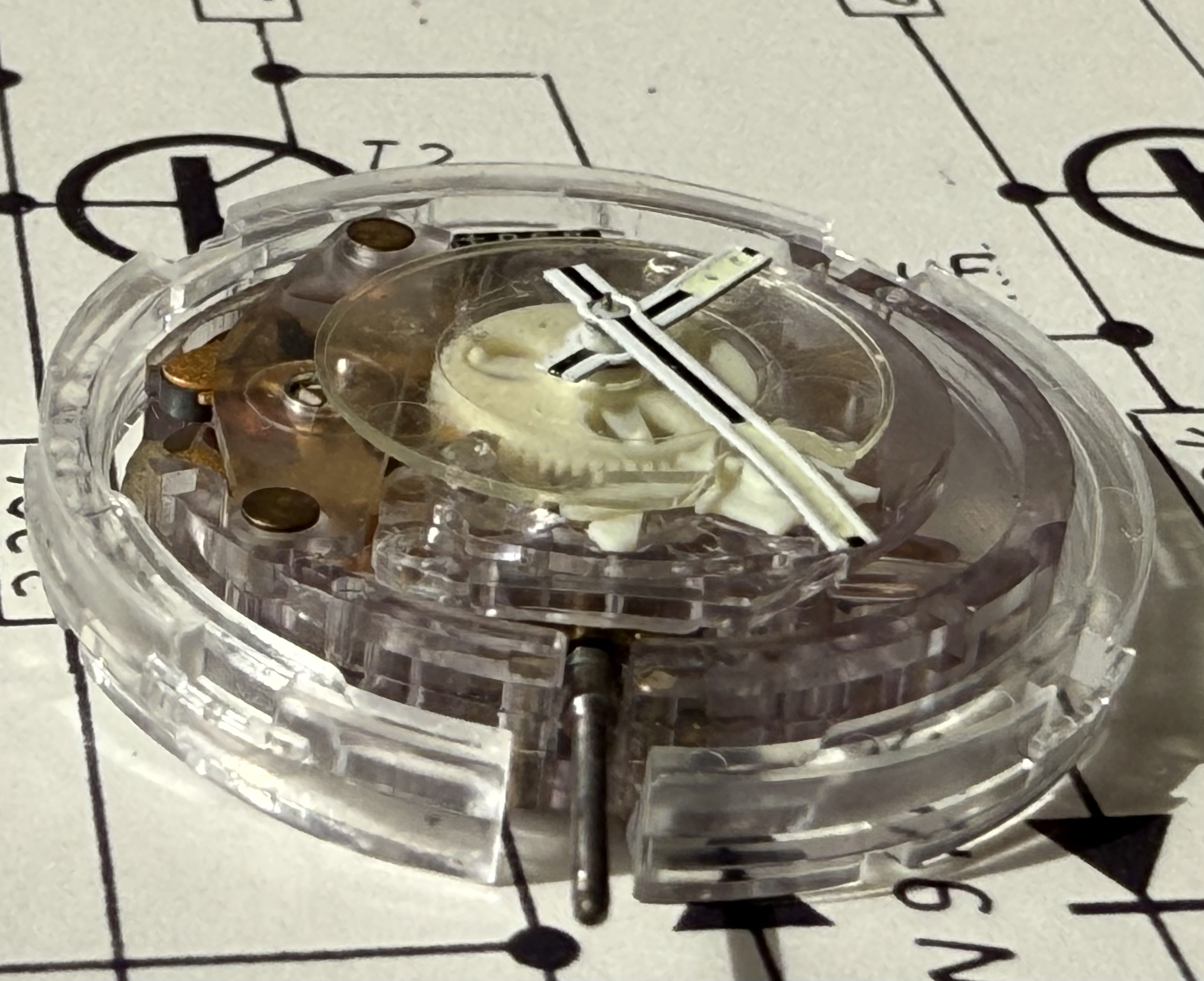


Prototype category: proof of concept
Description: Uncased, transparent plastic caliber. Caliber plates connected with minute screws. Two level, asymmetric, brass balance wheel with three magnets underneath the top level facing the oval, fixed coil. Discrete electronic elements building a primitive electric circuitry. Recess for battery and brass battery contacts. Top plate prepared for accepting plastic wheels activating a date disc. Plastic wheels for driving the hands, fixed by a transparent, small plate. Black and white hour and minute hands with lume application. Back marked in black with prototype number ’51’.
Dimensions: Movement diameter: 26mm (without clear protecting ring)
Movement: SYTAL cal.: 6550, #51
Additional Info: As mentioned above, Tissot was experimenting with plastic in horology since 1952, when they initiated the project named ‘SYTAL’ for ‘Système Tissot d’Auto-Lubrification’. As the project name implies, the goal was to have a caliber with no need for lubrication. This feature would considerably increase the life span and service intervals for a watch. The quest for the perfect synthetic oils and other solutions to improve the watch movement’s lives and to increase the intervals between services was one of the main goals of the Swiss watchmaking industry after WWII and before the frenetic research into battery driven wrist watches.
The research for plastic caliber parts was thus not solely motivated to cut costs at first, as there was the conviction, that plastic might bear better qualities than metal for some parts of the calibers, as it could be self lubricating, lightweight and by adding different compounds, also more versatile. Omega did even research the use of delrin ‘jewels’ instead of rubies in its calibers (5). Finally, the use of plastic crystallised as being cheaper, as it could be cast in volume, a feature which will be crucial for the Swiss watch industry with the introduction of Swatch in 1983.

Tissot’s research concentrating on a plastic caliber with no need of lubrication culminated in the development of the ‘Astrolon’ system, initiated in 1964 and finally launched at the Basle fair of 1971(1). The ‘Astrolon’ is a mechanical movement where the plates are riveted together making servicing of the movement impossible. If this was part of the concept implying that no service would be needed, a marketing feature or a way to cut production costs is not known. To finalise the project, the ‘Astrolon’ movement was cased inside a plastic case and marketed as ‘Research Idea 2001’ or ‘SYTAL’. The plastic cased versions were sold mostly in Italy. Other versions, some retaining the transparency of the lacking dial and discretely cased in metal cases with see through backs, were also sold in the US, for example by ‘Sears’ or ‘Walmart’. The ‘Astrolon’ at first initiated as a project for a futuristic, space inspired watch, was finally thought to concurrence the cheap Japanese quartz watches, but the market did not accept the cheap plastic, mechanical watch as an alternative.
The electromechanical prototype shown here features miniature screws holding the plates together. If this was initially part of the concept or only a feature thought to be used in prototypes to be able to easily dismantle, make changes and reassemble the movements remains unknown. The basic construction of this movement remains very similar to the ‘Astrolon’. The dimensions of the recesses for the wheel work, the pivot diameters and other parts differ from the ‘Astrolon’.
This movement retains other different unique features next to the fact, that it is battery driven: The time setting mechanism is mostly made of plastic, whereas in the later ‘Astrolon’ system this mechanism is completely made out of metal. It is conceivable, that a plastic time setting mechanism would be acceptable, as it is not used regularly in a battery driven movement. However, plastic seemed not compatible with the daily manipulation of these parts for winding the mechanical version.
This was the last version of the cal.: 6550 project and it was abandoned quite quickly, as by the end of 1968 it was clear, that better performing quartz movements would be soon available.
Provenance: Ex. Hans Baumann collection
Ref.:
- Tissotwatches
- IMBD
- Teddybaldassarre
- Bramaz H.-R., Baumann H.; Die Elektrische Armbanduhr, Band 1, Verlag Stutz Druck AG, Wädenswil, 2013
- @t_solo_t, personal communication
 Omega Prototypes